
Industrial Conveyor Solutions
High‑quality wire and conveyor belt solutions for demanding industrial processes.
Wire Mesh Belts
High‑quality wire belts for industrial processes
We supply a complete range of standard and custom‑engineered wire mesh belts for demanding industrial applications. Each belt type is manufactured with precision and configured to match your exact requirements from wire diameter and pitch to material selection and edge construction.
With deep technical expertise and flexible production capabilities, we deliver wire belts that offer excellent stability, high airflow, precise tracking, and long service life across a wide range of industries and temperature ranges.
Industrial Conveyor Systems
High‑performance conveyor solutions for demanding production environments
Our industrial conveyor systems are engineered for processes where reliability, precision, and long‑term durability are essential. We supply complete metal conveyor belt constructions including wire mesh belts, chain‑driven systems, flat‑flex designs, eye‑link belts, and honeycomb structures. Each configured to match the specific requirements of your production line.
Whether your process requires high airflow for drying, a stable carrying surface for baking, accurate tracking for automated handling, or a fully customized solution for a specialized application, we design every system to deliver consistent performance, smooth operation, and long service life.
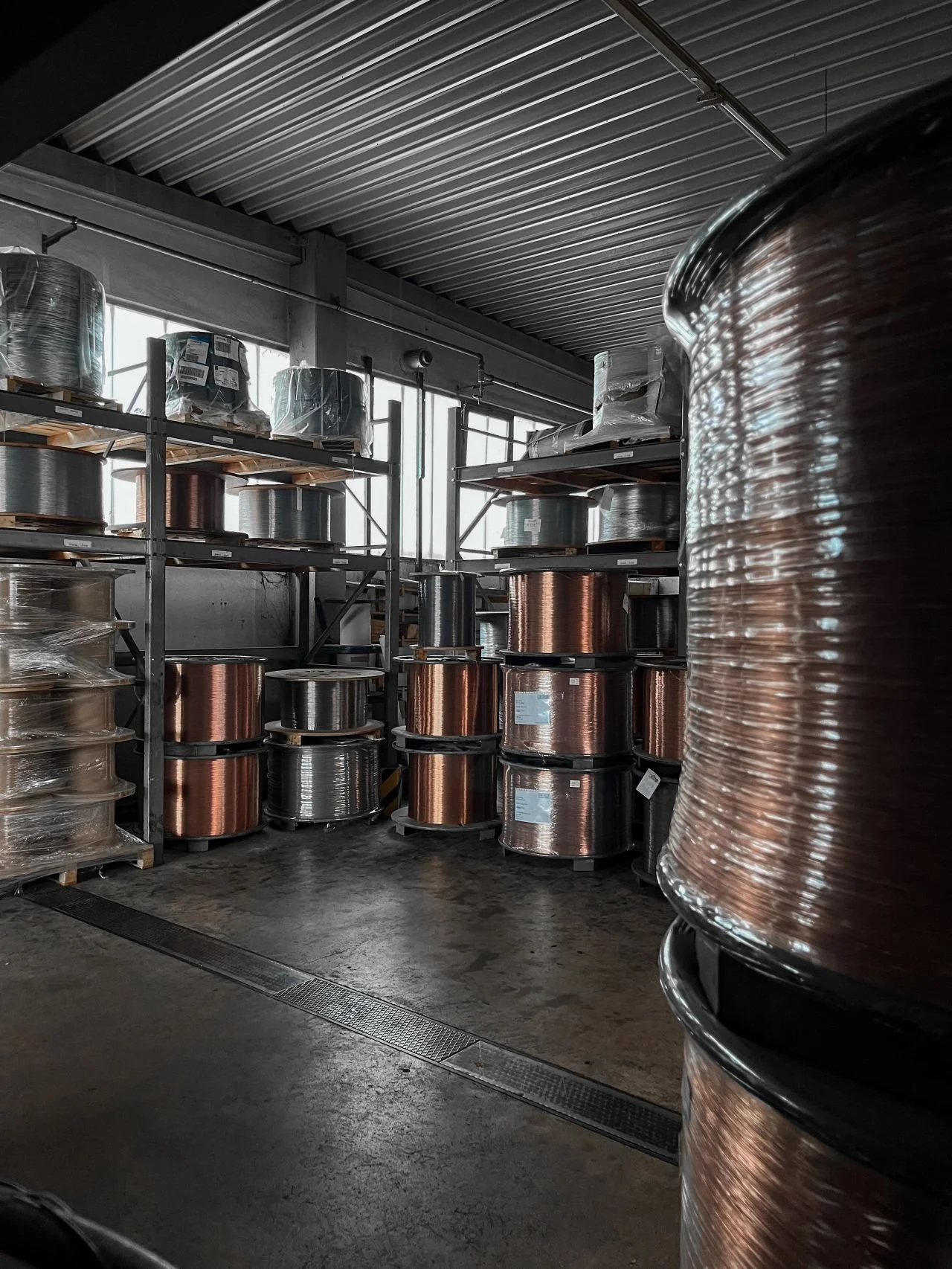
Engineered for Extreme Conditions
Our wire mesh belts are designed for high‑demand industrial environments. They withstand:
mechanical stress
corrosive atmospheres
extreme temperatures up to 1200°C
Suitable for drying, baking, heat treatment, filtration, cooling, and furnace applications with stable tracking and long service life.
Materials & Variants
Available in:
galvanised steel
stainless steel
heat‑resistant alloys
brass, bronze, copper, aluminium
Optional configurations:
chain guides
carrier profiles
trough edges
reinforced rods
positive‑drive systems
Engineered to match your exact process requirements.
Wire Mesh Belt Types
-
Wire link belt with closely wound spirals.
The Type 100 flat wire link belt features a close‑meshed woven construction with flat wire spirals wound alternately in right‑hand and left‑hand direction.
This tightly woven design provides excellent product support and is suitable for conveying small or delicate items. Depending on the conveying requirements, the cross rods can be supplied in either smooth or profiled design.Type 100 belts are commonly used in drying systems and continuous ovens. They can be manufactured from bright steel, galvanized steel, quenched and tempered steel, corrosion‑ and acid‑resistant chrome and chrome‑nickel steels, as well as high‑temperature‑resistant chrome and chrome‑nickel steels. Due to the close‑mesh construction, Type 100 is not available in multi‑fold configurations.
Application: drying devices and continuous heating furnaces
Edges: looped or bent edges
Spirals: from 1.2 x 0.7 mm to 4.0 x 2.0 mm
Cross-rods: diameters from 1.4 to 8.0 mm
Pitch: from 8.0 to 50.8 mm
Belt width: 5000 mm maximum<img src="https://images.squarespace-cdn.com/content/6a018c774559a87bf9861eb4/2c21cde3-454b-4db2-9f6f-f1107c52a011/Schulz012.jpg?content-type=image%2Fjpeg" alt="Type 100 flat wire link belt with closely wound flat wire spirals for industrial conveying applications.">
-
Round wire belt with close-meshed spirals
The Type 200 round wire link belt features a close‑meshed construction with round wire spirals wound alternately in right‑hand and left‑hand direction.
Depending on the conveying requirements, the cross rods can be supplied in either smooth or profiled design. The belt can be manufactured with looped or bent edges.Type 200 belts are commonly used in drying devices and continuous heating furnaces. They can be produced from bright steel, galvanized steel, quenched and tempered steel, corrosion‑ and acid‑resistant chrome and chrome‑nickel steels, as well as high‑temperature‑resistant chrome and chrome‑nickel steels.
Due to the tight spiral spacing, Type 200 is not available in multi‑fold configurations (2‑fold to 5‑fold).
Application: drying devises and continuous heating furnaces
Edges: looped or bent edges
Spirals: diameters from 0.8 to 5.0 mm
Cross bars: diameters from 1.4 to 8.0 mm
Pitch: 8 to 50.8 mm
Width: max. 5.000 mm maximum<img src="https://images.squarespace-cdn.com/content/6a018c774559a87bf9861eb4/a6d4f006-e8c0-47b6-be42-9ad723649c46/Schulz014.jpg?content-type=image%2Fjpeg" alt="Type 200 round wire link belt with alternating right- and left-hand wound spirals for industrial conveying applications.">
-
Wire link belt with wide-meshed spirals, available in up to five-strand configuration.
The Type 300 wide spiral flat wire link belt features a wide‑meshed construction with flat wire spirals wound alternately in right‑hand and left‑hand direction.
The cross rods are corrugated, providing additional stability and ensuring consistent belt tracking. Depending on the application, the belt can be supplied with either looped or welded edges.Type 300 belts are commonly used in drying equipment and continuous heating furnaces. They can be manufactured from bright steel, galvanized steel, quenched and tempered steel, corrosion‑ and acid‑resistant chrome and chrome‑nickel steels, as well as high‑temperature‑resistant chrome and chrome‑nickel steels.
In addition to the standard single‑spiral version, Type 300 can also be produced in multi‑fold configurations (2‑fold up to 5‑fold), offering increased strength and reduced deformation under load.
Application: drying devises and continuous heating furnaces
Edges: looped edges or welded edges
Spirals: from 1.2 x 0.7 mm to 4 x 2 mm
Pitch: 3.0 to 33.33 mm
Cross-rods: diameters from 1.0 to 8 mm
Pitch: from 4.0 to 50.8 mm
Width: max. 6.000 mm maximum<img src="https://images.squarespace-cdn.com/content/6a018c774559a87bf9861eb4/697b4f84-a502-4a70-a567-73af913e2d9c/Schulz005.jpg?content-type=image%2Fjpeg" alt="Type 300 wide spiral flat wire link belt with corrugated cross rods and optional multi-fold construction for industrial conveying applications.">
-
Wire link belt with wide-meshed spirals, available in up to five-strand configuration.
The Type 400 wide spiral round wire link belt features a wide‑meshed construction with round wire spirals wound alternately in right‑hand and left‑hand direction.
The corrugated cross rods provide additional stability and ensure reliable belt tracking. Depending on the application, the belt can be supplied with either looped or welded edges.Type 400 belts are commonly used in drying equipment and continuous heating furnaces. They can be manufactured from bright steel, galvanized steel, quenched and tempered steel, corrosion‑ and acid‑resistant chrome and chrome‑nickel steels, as well as high‑temperature‑resistant chrome and chrome‑nickel steels.
In addition to the standard single‑spiral version, Type 400 can also be produced in multi‑fold configurations (2‑fold up to 5‑fold), offering increased strength and reduced deformation under load.
Application: drying devices and continuous heating furnaces
Edges: looped or welded edges
Spirals: diameters from 0.8 to 5.0 mm
Pitch: 3.0 to 33.33 mm
Cross-rods: diameters from 1.0 to 8.0 mm
Pitch: from 4.0 to 50.8 mm
Width: 6.000 mm maximum<img src="https://images.squarespace-cdn.com/content/6a018c774559a87bf9861eb4/6f8f424f-3609-43fa-bd17-80482d18ff03/Schulz004.jpg?content-type=image%2Fjpeg" alt="Type 400 wide spiral round wire link belt with corrugated cross rods and optional multi-fold construction for industrial conveying applications.">
-
Spiral Mesh Belt with Flat-Oval Cross Section.
The Type 500 flat spiral wire link belt is constructed from flat oval spirals and can be manufactured either with single‑sided spirals or with alternating right‑ and left‑hand spiral sections. Depending on the application, the belt can be supplied with bent‑over, welded, or crimped edges.
Type 500 is designed for conveying light materials such as tobacco, bakery products, and rayon. It can be produced from bright steel, galvanized steel, quenched and tempered steel, and corrosion‑ and acid‑resistant chrome and chrome‑nickel steels.
Application: light conveyed material such as tobacco, bakery products, cell wool etc.
Edges: bent over, welded or crimped edges
Spirals: 0.5 to 3.0 mm
Mesh sizes: from 3.0 to 25 mm
Width: max. 6,000 mm maximum<img src="https://images.squarespace-cdn.com/content/6a018c774559a87bf9861eb4/579521c8-0cf1-4f46-a531-4085f852da89/Schulz007.jpg?content-type=image%2Fjpeg" alt="Type 500 wide spiral flat wire link belt with corrugated cross rods for heavy-duty industrial conveying applications.">
-
Round spiral wire mesh belt.
The Type 550 round spiral wire mesh belt is constructed from round spirals and can be manufactured either with single‑sided spirals or with alternating right‑ and left‑hand spiral sections. Depending on the application, the belt can be supplied with bent‑over, welded, or pressed edges.
Type 550 is designed for conveying light materials such as tobacco, bakery products, and rayon. It can be produced from bright steel, galvanized steel, quenched and tempered steel, and corrosion‑ and acid‑resistant chrome and chrome‑nickel steels.
Application: light conveyed material such as tobacco, bakery products, cell wool etc.
Edges: bent-over, welded or pressed edges
Spirals: diameters from 0.5 to 2 mm
Mesh sizes: from 1.75 to 10 mm
Width: max. 6,000 mm maximum<img src="https://images.squarespace-cdn.com/content/6a018c774559a87bf9861eb4/0283cae1-1ae0-40a8-b42c-7a2509db760c/Schulz008.jpg?content-type=image%2Fjpeg" alt="Type 550 wide spiral round wire link belt with corrugated cross rods for heavy-duty industrial conveying applications.">
-
Wire belt made of interwoven cross rods.
The Type 700 rod mesh belt is constructed from parallel rods connected by crimped cross wires, forming an open mesh design that offers excellent air and liquid permeability. This construction makes the belt suitable for transporting light products and for processes requiring efficient drainage or airflow.
Type 700 belts are commonly used for drying, washing, cooling, baking, and general transport of light conveyed goods. They can be manufactured from bright steel, galvanized steel, quenched and tempered steel, and corrosion‑ and acid‑resistant chrome and chrome‑nickel steels.
Application: light conveyed material, biscuit, confectionery, etc.
Cross wires: diameters from 0.9 to 2.8 mm
Pitch: from 3,5 to 22 mm
Mesh length: from 16 to 200 mm
Belt width: max. 6.000 mm maximum<img src="https://images.squarespace-cdn.com/content/6a018c774559a87bf9861eb4/d7747a43-2f2d-432d-b776-fa172cf9289f/Schulz003.jpg?content-type=image%2Fjpeg"alt="Type 700 rod network belt with parallel cross rods and woven spirals for heavy-duty industrial conveying applications.">
-
Wire belt made of wire eyelets and cross rods.
The Type 800 wire eyelet link belt is constructed from interlinked eyelets that are connected by cross rods, forming an open and flexible mesh structure. The eyelets are braided alternately in right‑hand and left‑hand direction, ensuring stable belt tracking and smooth operation.
Type 800 belts are commonly used for washing, drying, cooling, and the transport of light conveyed goods. They can be manufactured from bright steel, galvanized steel, quenched and tempered steel, and corrosion‑ and acid‑resistant chrome and chrome‑nickel steels.
Application: food transport, drying, cooling and washing units
Gauge of eyelet: diameters from 1.6 to 3.4 mm
Pitch: from 25.4 to 50.8 mm
Width: 6,000 mm maximum<img src="https://images.squarespace-cdn.com/content/6a018c774559a87bf9861eb4/648ed8e4-4cc5-40ae-ab88-9cda327d3acf/Schulz002.jpg?content-type=image%2Fjpeg"alt="Type 800 wire eyelet link belt with alternating right- and left-hand braided eyelets for washing, drying, cooling and light conveying applications.">
-
Spiral mesh belt with spirals of Type 550 in a double configuration.
The Type 1100 double spiral belt is constructed from round spirals (Type 550) that are double‑twisted and braided on one side. The belt is equipped with welded edges and smooth cross bars, resulting in a stable and durable mesh structure suitable for continuous operation.
Type 1100 belts are commonly used for bakery products, bottle transport in the chemical industry, and similar light conveyed goods. They can be manufactured from SM steel, bright steel, galvanized steel, quenched and tempered steel, and corrosion‑ and acid‑resistant chrome and chrome‑nickel steels.
Application: Baked goods, bottle transport in the chemical industry
Spirals: diameteters from 1.0 to 1.6 mm
Cross bars: diamaters from 1.2 to 1.6 mm
Pitch: from 3.2 to 5.4 mmIncrease:from 2.5 to 4.0 mm
Belt width: 6,000 mm maximum<img src="https://images.squarespace-cdn.com/content/6a018c774559a87bf9861eb4/380dc72d-7050-4bd7-a2e7-1444e5276e93/Type+1100++-+Double+spiral+belt.png?content-type=image%2Fpng" alt="Type 1100 double spiral belt with double-twisted round spirals, welded edges and smooth cross bars for light industrial conveying applications.">
-
Spiral mesh link belt with flat-oval spirals and smooth cross rods.
The Type 1300 braided link belt is braided on one side and equipped with welded edges, smooth spirals, and smooth cross bars. This construction provides a stable and durable belt structure suitable for continuous operation under high thermal loads.
Type 1300 belts are commonly used in continuous heating furnaces for tempering, hardening, and cooling processes. They are manufactured exclusively from high‑heat‑resistant chromium and chrome‑nickel steels, including grades such as 1.4828, 1.4841, 1.4843, 1.4864, and 2.4869.
Application: Continuous heating furnaces for tempering, hardening and cooling
Spirals: diameters from 2.0 to 4.0 mm
Cross bars: diameters from 2.5 to 5.0 mm
Pitch: from 12 to 25 mm
Increase: from 12 to 20 mm
Belt width: 5,000 mm maximum<img src="https://images.squarespace-cdn.com/content/6a018c774559a87bf9861eb4/1ae28e4e-00fb-4559-8cd3-4de2beeaff47/Schulz011.jpg?content-type=image%2Fjpeg" alt="Type 1300 braided link belt with alternating right- and left-hand flat wire spirals and smooth cross rods for industrial conveying applications.">
-
Individual wire belts for specific fields of application
In addition to the standard program, we also manufacture fully customized wire belts designed for specific conveying requirements. Based on individual parameters such as braid type, material selection, and belt edge design, we configure and produce tailor‑made solutions for a wide range of applications.
Custom wire belts can be equipped with chain guides for slip‑free drive, carrier profiles for transporting products over inclines or declines, and trough edges that seal the sides of the belt and prevent material from falling off. These trough edges are developed specifically for the conveyed product to ensure optimal performance.
Examples of individual constructions include multi‑part belts combining different belt types, round wire link belts with channel edges and hollow pin chains, and wide spiral belts (Types 300 and 400) in multi‑fold configurations such as 2‑fold, 3‑fold, or 5‑fold. Chain‑driven belts often referred to as Type 900 are also part of this category and are not listed as a separate standard type.
<img src="https://images.squarespace-cdn.com/content/6a018c774559a87bf9861eb4/eed6541e-3cc0-45bf-9587-540c006764e6/Individual+wire+belt+2.jpg?content-type=image%2Fjpeg" alt="Custom individual wire belt with tailored spiral construction, optional chain guides, carrier profiles and trough edges for specialized industrial conveying applications.">
Belt Edges
-
Slat edges feature reinforced side plates that provide exceptional lateral stability.
This edge type is used on Type 800 belts for applications requiring precise tracking and high load capacity.<img src="https://images.squarespace-cdn.com/content/6a018c774559a87bf9861eb4/bdec2824-6504-4be7-9bb5-0ddb7a4dc221/Slat+Edge.jpg?content-type=image%2Fjpeg" alt="Slat edge with reinforced side plates providing exceptional lateral stability for Type 800 wire belts requiring precise tracking and high load capacity.">
-
Welded edges provide maximum stability by welding the cross rods directly to the belt edge.
This prevents edge deformation and ensures reliable performance under heavy loads.
Available for Types 100, 200, 300, 400, 500, 550, 1100, and 1300.<img src="https://images.squarespace-cdn.com/content/6a018c774559a87bf9861eb4/7c585faf-6073-439d-b1e6-877f268eeddf/Welded+Edge.jpg?content-type=image%2Fjpeg" alt="Welded edge with cross rods welded directly to the belt edge for maximum stability, preventing edge deformation and ensuring reliable performance under heavy loads. Suitable for Types 100, 200, 300, 400, 500, 550, 1100 and 1300.">
-
Bent edges are created by bending the cross rods at the belt edge.
This design improves lateral stability and is available for Types 100, 200, 300, 400, 500, and 550.<img src="https://images.squarespace-cdn.com/content/6a018c774559a87bf9861eb4/cc5dc881-4e30-4cf9-a807-ccdcd7b604b8/Bent+Edge.jpg?content-type=image%2Fjpeg" alt="Bent edge created by bending the cross rods at the belt edge, improving lateral stability. Suitable for Types 100, 200, 300, 400, 500 and 550.">
-
Flattened loop edges are pressed into a low‑profile shape to improve tracking and reduce wear.
This edge type is available for Types 100, 200, 300, and 400.<img src="https://images.squarespace-cdn.com/content/6a018c774559a87bf9861eb4/0d25425d-2007-4219-8c86-fb4f4e3483a7/Flattened+loop+Edge.jpg?content-type=image%2Fjpeg" alt="Flattened loop edge pressed into a low-profile shape to improve tracking and reduce wear. Suitable for Types 100, 200, 300 and 400.">
-
Hollow‑bolt chain edges use side chains with hollow pins for positive drive and high strength.
This edge type is available for Types 100, 200, 300, 400, 500, 550, and 800.<img src="https://images.squarespace-cdn.com/content/6a018c774559a87bf9861eb4/4d1976f8-9ef0-47aa-997d-2ff6751b9d75/Hollow+Bolt+Chain.png?content-type=image%2Fpng" alt="Hollow-bolt chain edge using side chains with hollow pins for positive drive and high strength. Suitable for Types 100, 200, 300, 400, 500, 550 and 800.">
-
Looped edges are formed by bending the spiral ends into rounded loops.
This classic edge design provides smooth guidance and is available for Types 100, 200, 300, and 400.<img src="https://images.squarespace-cdn.com/content/6a018c774559a87bf9861eb4/0ade9535-992f-4634-8e31-654a0ca3c0b2/Looped+Edge.jpg?content-type=image%2Fjpeg" alt="Looped edge formed by bending the spiral ends into rounded loops, providing smooth guidance. Suitable for Types 100, 200, 300 and 400.">
Drive Wheels
-
Designed for the Type 800 wire eye link belt, this drive wheel ensures stable and consistent belt operation.
<img src="https://images.squarespace-cdn.com/content/6a018c774559a87bf9861eb4/baee0595-e05a-46a8-b50d-45dd15161731/typ-800.webp?content-type=image%2Fwebp" alt="Drive wheel designed for the Type 800 wire eye link belt, ensuring stable and consistent belt operation.">
-
These drive wheels are engineered for Type 300 and Type 400 wide‑spiral belts, ensuring precise, positive engagement and reliable belt tracking.
<img src="https://images.squarespace-cdn.com/content/6a018c774559a87bf9861eb4/82a3148e-7344-49f2-b24a-bfeeeed9ed78/typ300.webp?content-type=image%2Fwebp" alt="Drive wheel engineered for Type 300 and Type 400 wide-spiral belts, ensuring precise positive engagement and reliable belt tracking.">
-
This drive wheel is designed specifically for Type 700 rod mesh belts, ensuring precise engagement and reliable, long‑term belt performance.
<img src="https://images.squarespace-cdn.com/content/6a018c774559a87bf9861eb4/72831590-5223-44cd-9572-def6c73d8b04/typ-700.webp?content-type=image%2Fwebp" alt="Drive wheel designed for Type 700 rod mesh belts, ensuring precise engagement and reliable long-term belt performance.">
Interested in Our Products?
Get in touch to learn more about our solutions and how they can work for you.